Quick Definition
Hydrogen Storage is the process of retaining hydrogen in compressed, liquefied, or solid-state form for later use as a clean energy carrier in transportation, industrial, and power generation applications.
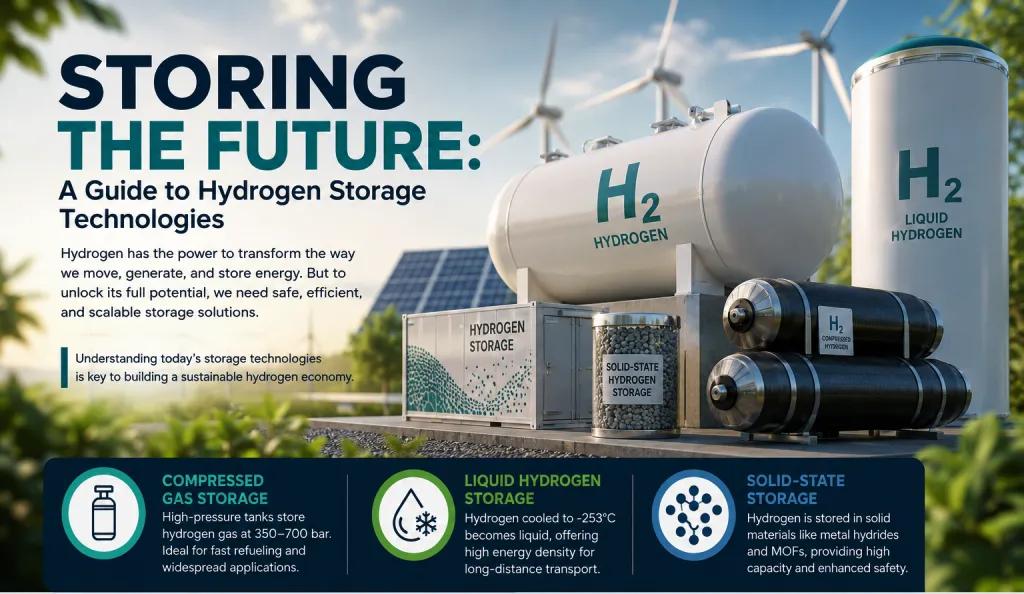
Hydrogen is no longer just a textbook element. It is fast becoming the backbone of the world's clean energy transition — powering fuel cell vehicles, feeding industrial processes, and serving as long-duration energy storage for grids increasingly driven by intermittent solar and wind. Global governments have committed hundreds of billions of dollars to hydrogen roadmaps, and project pipelines from South Korea to Germany to India are accelerating at a pace few predicted even five years ago.
Yet for all the momentum, one fundamental challenge continues to define hydrogen's viability: how do you store it? Hydrogen is the lightest element in the universe. At ambient conditions it exists as a low-density gas, meaning enormous volumes are needed to hold commercially useful quantities of energy. Getting around this physical reality is the central engineering problem of the hydrogen economy — and the solutions available today are more varied, more mature, and more fascinating than most people realise.
This guide walks through the three primary hydrogen storage technologies — compressed gas, liquid hydrogen, and solid-state storage — examines the trade-offs each brings, and offers a practical framework for choosing the right approach based on application requirements.
Why Storage Is the Hydrogen Economy's Hardest Problem
Unlike natural gas or petrol, hydrogen cannot simply be pumped into a conventional tank and left sitting. Its extremely low volumetric energy density at standard temperature and pressure (roughly 0.003 kg per litre) means that storing even a few kilograms for practical use requires either pressurising the gas to several hundred times atmospheric pressure, cooling it to near absolute zero, or chemically binding it within a solid material.
Each of these approaches comes with its own capital costs, energy penalties, safety considerations, and suitability for different applications. There is no universal solution. The right storage technology depends entirely on what you need the hydrogen to do, how much you need to store, how quickly you need to access it, and what infrastructure already exists around it.
Technology 1: Compressed Gas Storage
How It Works:
Compressed gas storage is the most widely deployed hydrogen storage method in use today. Hydrogen is pressurised using multi-stage compressors and stored in high-strength tanks at pressures typically ranging from 350 to 700 bar — that is 350 to 700 times atmospheric pressure. The tanks themselves have evolved considerably over the decades, from basic steel cylinders (Type I) to fully composite carbon-fibre reinforced polymer vessels (Type IV) that offer remarkable strength at a fraction of the weight.
Safety systems are integral to the design. High-integrity seals, pressure relief valves, and burst discs ensure that any overpressure event is managed in a controlled way. Modern Type III and Type IV tanks used in fuel cell vehicles, for example, are engineered to withstand crash scenarios, fire exposure, and extreme temperature cycling.
Where It Shines
Compressed gas storage is the go-to choice for hydrogen refuelling stations, industrial gas supply, and onboard vehicle storage. Its biggest advantage is speed: a fuel cell car can be refuelled in three to five minutes, matching the convenience of conventional petrol vehicles and far outpacing battery electric vehicles in high-utilisation fleet scenarios such as taxis, trucks, and buses.
The technology is commercially mature. Compressors, dispensers, and storage vessels are manufactured at scale by established suppliers across multiple continents. For engineering institutions building hydrogen labs, compressed gas cylinders are the simplest and most accessible starting point.
The Trade-Offs
The compression process itself is energy-intensive, consuming roughly 15% of the energy content of the hydrogen being stored. At large scale, this is a meaningful efficiency penalty. High-pressure vessels also require robust and expensive infrastructure. Fuelling station forecourts look very different from petrol stations, and retrofitting existing sites can be challenging. The volumetric density, while improved over ambient-pressure gas, still lags behind liquid and solid-state options. Whatever the storage pressure, verifying delivered gas purity and monitoring for leaks at every connection point remains essential across the full system.
Technology 2: Liquid Hydrogen Storage
How It Works
Hydrogen liquefies at approximately minus 253 degrees Celsius, just 20 degrees above absolute zero. At this temperature, hydrogen transitions into a liquid with a density roughly 800 times greater than the gas at atmospheric conditions, dramatically improving storage efficiency. The liquefaction process involves multiple cooling stages using the Joule-Thomson effect and cryogenic expansion cycles, and the resulting liquid hydrogen is held in double-walled vacuum-insulated cryogenic tanks.
Managing boil-off (the gradual evaporation of liquid hydrogen as heat inevitably permeates even the best insulation) is a critical operational consideration. Modern tanks incorporate vapour recovery systems that recapture boil-off gas rather than venting it, improving both safety and efficiency. Boil-off rates for well-designed stationary tanks can be kept below 1% per day, though mobile or smaller-scale applications see higher rates.
Where It Shines
Liquid hydrogen has been the storage method of choice for aerospace and space exploration for decades. NASA's Saturn V rocket and the Space Shuttle both relied on it, and current launch vehicles from SpaceX and others continue the tradition. For long-distance hydrogen transportation — moving large quantities by ship or road tanker — the higher energy density of liquid hydrogen makes it significantly more economical than trucking compressed gas.
Large-scale hydrogen import terminals under development in Japan, Germany, and Australia are designed around liquid hydrogen. As the global hydrogen trade matures over the next decade, liquid hydrogen shipping corridors are expected to become a primary mode of international energy transfer.
The Trade-Offs
The energy cost of liquefaction is substantial — between 30 and 40% of the hydrogen's energy content, compared to 15% for compression. Cryogenic infrastructure is expensive to build and requires highly specialised maintenance expertise. Boil-off losses, particularly during transfer and in smaller tanks, erode efficiency further. For applications that do not require the density advantage of liquid hydrogen, the cost and complexity rarely justify the choice.
Technology 3: Solid-State Hydrogen Storage
How It Works
Solid-state hydrogen storage works on a fundamentally different principle. Rather than physically containing hydrogen gas or liquid, it chemically or physically bonds hydrogen atoms within a solid material, releasing them on demand by adjusting temperature and pressure. The three main material classes are metal hydrides, chemical hydrides including borohydrides, and high-surface-area porous materials such as metal-organic frameworks (MOFs).
Metal hydrides like LaNi5 and iron-titanium alloys absorb hydrogen reversibly at moderate temperatures between 20 and 300 degrees Celsius, making them practical for repeated charge-discharge cycling. Chemical hydrides such as sodium borohydride and lithium borohydride offer higher gravimetric hydrogen capacity, up to 18% by weight, but typically require higher decomposition temperatures above 300 degrees Celsius, and reversibility remains a research challenge. MOFs operate through physisorption at cryogenic conditions and are better suited to laboratory-scale and research applications at present.
Where It Shines
Solid-state storage offers the best volumetric energy density of the three approaches and can operate at significantly lower pressures than compressed gas, which is a meaningful safety advantage in densely populated or indoor environments. This makes it particularly attractive for stationary backup power systems, grid-scale energy storage, hydrogen-powered drones and small unmanned aerial vehicles, and niche mobile applications where space is severely constrained.
For engineering researchers and institutions, solid-state storage materials represent one of the most active and intellectually exciting areas of materials science. Studying hydrogen absorption kinetics, cycle degradation, and novel alloy compositions offers rich experimental territory that connects chemistry, materials engineering, and energy systems.
The Trade-Offs
Material costs for many high-performance hydrides remain high, and the weight of the storage medium itself can offset the volumetric density gains on a gravimetric basis. Hydrogen uptake and release rates are slower than gas or liquid systems, which limits suitability for applications requiring rapid fuelling or high power draw. Some materials degrade over repeated absorption-desorption cycles, raising questions about long-term operational cost. Many high-capacity options remain at demonstration or pre-commercial scale.
Choosing the Right Technology: A Practical Framework
No single technology wins across all dimensions. The following questions should guide selection:
- Application type: Transportation and refuelling applications align naturally with compressed gas. Long-haul transport and aerospace favour liquid hydrogen. Stationary storage and safety-sensitive indoor installations point toward solid-state.
- Storage duration: Short-duration buffer storage suits compressed gas well. Long-duration strategic reserves favour liquid or solid-state approaches where boil-off and slow release rates are less disqualifying.
- Energy efficiency priority: Compressed gas is the most efficient of the three when the full energy pathway is considered, particularly for small to medium scale. Liquid hydrogen's large liquefaction penalty only makes sense at high volumes.
- Infrastructure readiness: Compressed gas can be deployed with relatively modest site modifications. Liquid hydrogen demands cryogenic plant and specialist operators. Solid-state requires material supply chains that remain immature in many markets.
- Safety constraints: For indoor or urban deployments where high-pressure or cryogenic systems are undesirable, solid-state storage operating at near-ambient conditions offers a compelling safety profile.
- Budget: Compressed gas technology is the most cost-competitive today. Liquid hydrogen involves high capital expenditure. Solid-state materials are improving but still carry a cost premium.
Comparing Hydrogen Storage Technologies
| Technology | Compressed Gas | Liquid Hydrogen | Solid-state |
|---|---|---|---|
| Storage method | Pressurised gas, 350–700 bar | Cryogenic liquid, −253 °C | Chemical/physical bonding in solid material |
| Volumetric density | Medium | High | Highest |
| Energy for storage | ~15% of H₂ energy | 30–40% of H₂ energy | Moderate (heat input) |
| Operating pressure | 350–700 bar | Near atmospheric | Low to moderate |
| Technology maturity | Commercial | Commercial | Emerging / pre-commercial |
| Refuelling / release speed | Fast (3–5 min) | Fast | Slow |
| Safety profile | High pressure risk | Cryogenic risk | High (materials) |
| Best for | Fuelling stations, vehicles, industrial | Long-distance transport, aerospace | Stationary storage, drones, space-constrained mobile use |
The Road Ahead
Hydrogen storage technology is not standing still. Composite tank manufacturers are pushing Type IV vessels to higher pressures with lower weight penalties. Cryogenic insulation research is steadily reducing boil-off rates. The materials science community is delivering new hydride compositions and MOF architectures at a rapid pace, and several solid-state systems are moving from laboratory to pilot scale.
Perhaps most significantly, system integration is improving. Compressed gas and solid-state technologies are increasingly being combined in hybrid architectures, using metal hydrides as buffer storage to smooth the pressure fluctuations of compressed gas systems. Liquid hydrogen is being reconsidered for heavy-duty long-haul trucking as cryogenic pump and insulation costs come down.
For engineering institutions, this is a landscape full of opportunity. Students who graduate with hands-on experience across all three storage modalities (understanding not just the theory but the experimental realities of compression, cryogenics, and materials cycling) will be exceptionally well positioned for careers in an industry growing faster than the talent pipeline currently feeding it. Building that hands-on experience typically starts with the same instrumentation used in real hydrogen systems: pressure monitoringand purity verification regardless of which storage technology a lab is working with.
At Hydrogenergy Technologies, we have spent significant time in building laboratory platforms that put this kind of learning into practice. Our hydrogen and fuel cell lab systems give students and researchers direct experience with the technologies shaping the energy transition, because understanding hydrogen storage from a textbook is a starting point, but working with it in the lab is where real competence is built.
Need help with your hydrogen project?
Our engineers respond within 24 hours with a recommendation.

Hydrogenergy Applications Engineering Team
Applications Engineering · Hydrogenergy Technologies
Hydrogenergy's applications engineering team designs and supplies hydrogen systems for research labs and industry across India — from components to complete commissioned setups.