Quick Definition
Hydrogen storage is the process of safely storing hydrogen in physical or material-based forms for later use in transportation, power generation, and industrial applications. The five principal storage methods, compressed gas, liquid hydrogen, metal hydrides, chemical hydrides, and cryo-compressed storage, offer different trade-offs in energy density, safety, cost, and operating conditions.
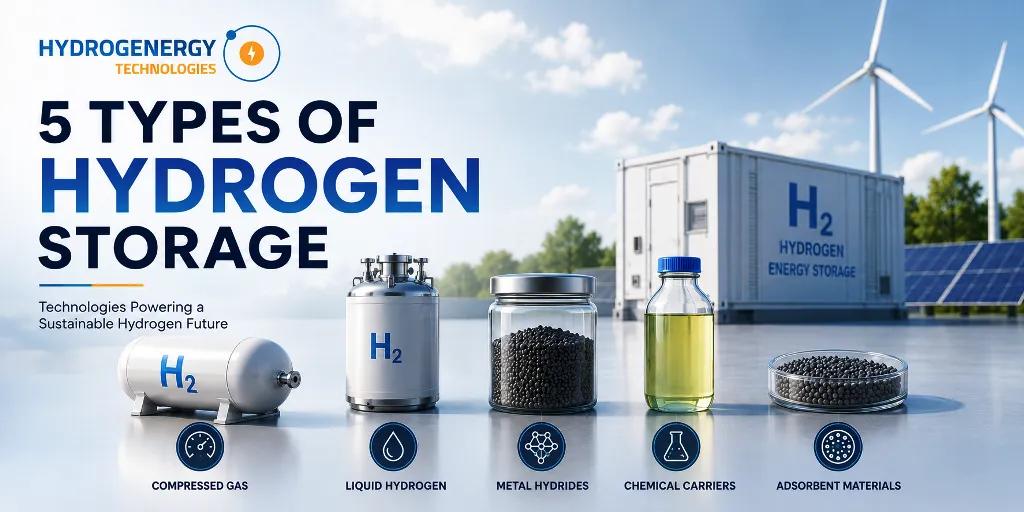
Hydrogen, recognized for its potential as a clean energy carrier, necessitates effective storage solutions to facilitate its widespread adoption in various sectors, including transportation, industry, and power generation. This blog covers the five primary hydrogen storage methods (compressed gas, liquid hydrogen, metal hydrides, chemical hydrides, and cryo-compressed hydrogen), examining their advantages and disadvantages for students, researchers, and professionals in the hydrogen and net zero industry.
Quick Comparison
| Method | Storage Density | Key Advantage | Key Disadvantage | Maturity |
|---|---|---|---|---|
| Compressed Gas | Moderate | Simple, mature, scalable | Energy-intensive compression, safety concerns | Fully mature |
| Liquid Hydrogen | High | Very high volumetric density | Boil-off losses, complex cryogenic infrastructure | Established, especially in aerospace |
| Metal Hydride | High | Chemically bound, safer | Heavy, thermal management needed | Commercial, growing |
| Chemical Hydride | High | Stable at ambient conditions | Regeneration and waste management complexity | Emerging |
| Cryo-Compressed | Very high | Combines density benefits of both approaches | Most complex and expensive system | Emerging |
1. Compressed Gas Storage
Overview: Compressed gas storage involves storing hydrogen gas in high-pressure cylinders. Typical storage pressures range from 350 to 700 bar (5,000 to 10,000 psi), with advancements in materials technology allowing for higher pressures.
Advantages: Simplicity and maturity, this technology is well-understood and commercially available, making it a straightforward option for hydrogen storage. Scalability, this method scales from small portable cylinders to large-scale storage systems. Efficiency, compression systems can be highly efficient, with well-established processes for compressing and decompressing hydrogen.
Disadvantages: Energy intensive, compressing hydrogen to high pressures requires significant energy input, which can impact overall efficiency and cost-effectiveness. Safety concerns, high-pressure storage poses risks including potential leaks, requiring robust safety measures and monitoring. Material challenges, storage vessels must be constructed from materials that withstand high pressures and resist hydrogen embrittlement, which can cause material degradation over time.
2. Liquid Hydrogen Storage
Overview: Liquid hydrogen storage involves cooling hydrogen gas to cryogenic temperatures (approximately -253°C or -423°F) to convert it into a liquid state, significantly increasing its volumetric energy density.
Advantages: High energy density, liquid hydrogen has a higher energy density compared to compressed gas, enabling more hydrogen to be stored in a given volume. Transportation efficiency, the higher density facilitates more efficient transportation, especially over long distances. Established technology, liquid hydrogen technology is well-established, particularly in aerospace, where it has been used as rocket fuel.
Disadvantages: Cryogenic temperatures require sophisticated insulation and refrigeration systems, leading to higher costs and energy consumption. Boil-off losses occur as hydrogen evaporates during storage and transportation, necessitating continuous cooling. Infrastructure requirements are more complex and expensive compared to compressed gas systems.
3. Metal Hydride Storage
Overview: Metal hydrides involve storing hydrogen within a metal lattice, where hydrogen molecules dissociate into atoms and are absorbed by the metal. Common metal hydrides include magnesium hydride and sodium alanate.
Advantages: High density, metal hydrides can store hydrogen at higher densities compared to compressed gas and even some liquid hydrogen systems. Safety, hydrogen stored in metal hydrides is chemically bound, reducing leak and explosion risk. Reversibility, many metal hydride systems offer reversible hydrogen absorption and desorption, enabling repeated use.
Disadvantages: Weight, metal hydride storage systems tend to be heavier, a disadvantage for mobile applications like vehicles. Thermal management, absorption and desorption are exothermic and endothermic processes respectively, requiring effective thermal management. Material cost, the metals used can be expensive, impacting overall system cost.
For a deeper look at real-world commercial progress in this specific storage method, including named companies and 2026 milestones, see our dedicated guide to metal hydride storage.
4. Chemical Hydride Storage
Overview: Chemical hydrides store hydrogen through chemical reactions, typically involving compounds such as sodium borohydride or ammonia borane. Hydrogen is released through hydrolysis or thermal decomposition.
Advantages: High storage density makes chemical hydrides suitable for portable and stationary applications. Stability at ambient conditions reduces the need for high-pressure or cryogenic storage. Ease of handling means many chemical hydrides are straightforward to handle and transport in solid or liquid form.
Disadvantages: Hydrogen release often requires additional processes like heating or reacting with water, which can be energy-intensive. Regeneration of spent chemical hydrides for reuse can be complex and costly. Waste management is needed for byproducts generated during hydrogen release, adding system complexity.
5. Cryo-Compressed Hydrogen Storage
Overview: Cryo-compressed hydrogen storage combines the principles of compressed gas and cryogenic liquid storage. Hydrogen is stored at cryogenic temperatures and under pressure, maximizing volumetric energy density.
Advantages: Enhanced density achieves higher hydrogen density compared to standalone compressed or liquid hydrogen storage. Reduced boil-off results from combining pressure and cryogenic temperatures. Efficiency comes from leveraging the benefits of both high-pressure and low-temperature storage.
Disadvantages: Complexity requires advanced materials and insulation technologies to maintain both pressure and cryogenic temperatures. Cost is higher for both infrastructure and operation given this complexity. Thermal management is critical to prevent temperature fluctuations and maintain system integrity.
Conclusion
The choice of hydrogen storage method depends on specific application requirements, including storage capacity, safety, cost, and infrastructure compatibility. Each of the five methods covered here, compressed gas, liquid hydrogen, metal hydrides, chemical hydrides, and cryo-compressed hydrogen, offers distinct advantages and disadvantages. Understanding these trade-offs is essential for specifying the right hydrogen storage solution for a given application, whether for research, industrial, or transportation use. Hydrogenergy supplies pressure monitoring and gas handling instrumentation relevant to compressed gas storage systems specifically, alongside broader technical support across storage technology selection.
Need help with your hydrogen project?
Our engineers respond within 24 hours with a recommendation.

Hydrogenergy Applications Engineering Team
Applications Engineering · Hydrogenergy Technologies
Hydrogenergy's applications engineering team designs and supplies hydrogen systems for research labs and industry across India — from components to complete commissioned setups.