Academic Labs

All Lab Systems
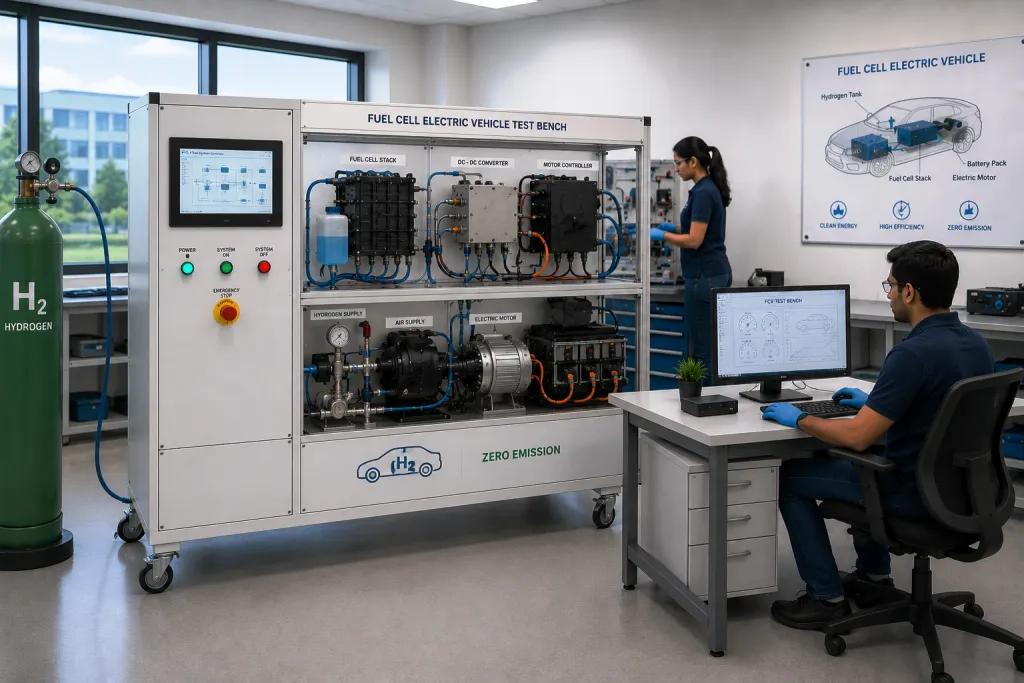
Solar to Hydrogen Production Learning SystemPEM Fuel Cell Learning SystemFuel Cell Electric Vehicle Learning SystemFuel Cell Benchmarking System

Need a custom lab configuration?

Discuss Your Lab →
Fuel Cell Benchmarking System
Academic Labs · Fuel Cell Benchmarking System

Fuel Cell Benchmarking System

Automated fuel cell characterisation and stack benchmarking for research labs.

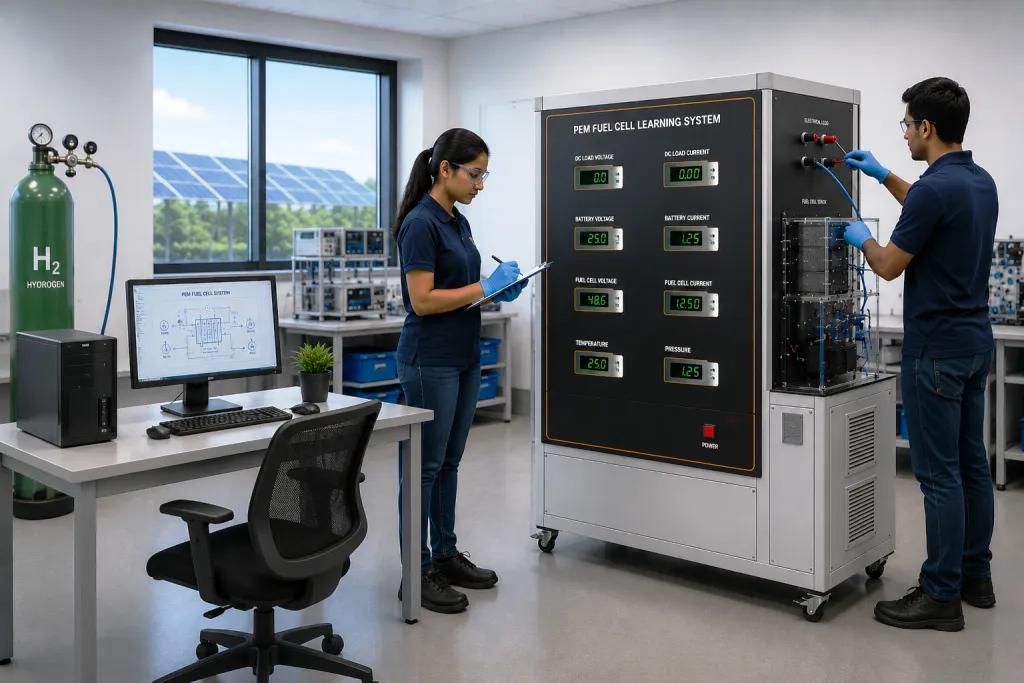
The Fuel Cell Benchmarking System is a research-grade platform for evaluating, characterising and comparing PEM fuel cell stacks under controlled, repeatable operating conditions. A programmable DC electronic load, mass flow controllers for hydrogen and air, individual cell voltage monitoring, real-time data acquisition and automated test sequencing give researchers the tools to generate accurate polarisation curves, measure hydrogen utilisation efficiency, study degradation and benchmark different stack configurations — without the limitations of manual benchtop setups.

Fuel Cell Benchmarking System

Specifications

Fuel Cell CompatibilityPEM stacks — user selectable
Stack MountingModular fixture with standardised interface panel
Electronic LoadProgrammable DC — constant current, constant voltage, dynamic profiles
H₂ SupplyCylinder interface with pressure regulation and MFC
Parameters MeasuredVoltage, current, H₂ flow, air flow, temperature, pressure
Data AcquisitionReal-time monitoring, automated test sequencing, data logging
Performance AnalysisPolarisation curve, power curve, efficiency, degradation

What this system does

The Fuel Cell Benchmarking System gives researchers and engineers a structured, automated environment for fuel cell performance evaluation. The system accepts user-supplied PEM fuel cell stacks in its modular mounting fixture and connects them through a standardised interface panel and stack protection system. Hydrogen is delivered at controlled flow rate and pressure via a mass flow controller and pressure regulation assembly with integrated safety. Air is supplied through a controlled delivery unit with flow meter and optional humidity control. The programmable DC electronic load applies constant current, constant voltage or dynamic load profiles — including automated load cycling — while the measurement system simultaneously logs fuel cell voltage, individual cell voltages, current, hydrogen and air flow rates, temperature and pressure. The real-time monitoring software provides automated test sequencing, performance analysis and data logging. Researchers can generate complete polarisation curves, power curves and efficiency maps across operating conditions, compare multiple stacks against a consistent protocol, study degradation over time and investigate the effect of temperature, pressure, humidity and stoichiometry on stack performance — all from a single integrated platform.

What's included

Fuel Cell Test Platform: PEM fuel cell stack mounting fixture — modular, accepts user-supplied stacks, Fuel cell interface panel with standardised connections Stack protection system
Hydrogen Supply Unit: Hydrogen storage cylinder interface, Pressure regulation system, Mass flow control unit, Hydrogen safety assembly with leak detection and automatic shutdown
Air Supply System:Controlled air delivery unit, Air flow meter Air pressure regulation system,Optional humidity control module
Electronic Load System: Programmable DC electronic load,Dynamic load profile generation,Constant current / constant voltage modes, Automated load cycling
Measurement and Instrumentation:Fuel cell voltage monitoring,Individual cell voltage measurement,Current measurement,Hydrogen flow measurement,Air flow measurement,Temperature monitoring,Pressure monitoring
Data Acquisition and Control:Real-time monitoring software,Automated test sequencing,Data logging system,Performance analysis interface

Experiments this system enables

Fuel cell polarisation curve generation — V-I and P-I at controlled conditions
Fuel cell power curve analysis across current density range
Hydrogen consumption measurement and fuel utilisation efficiency determination
Air-to-fuel stoichiometry studies and optimisation
Load response characterisation — step and dynamic load changes
Dynamic load profile testing — custom and standard profiles
Individual cell voltage distribution analysis — uniformity across the stack
Effect of temperature on fuel cell performance and efficiency
Effect of cathode and anode pressure on output voltage and power
Comparative benchmarking of multiple stacks against a consistent test protocol
Fuel cell degradation and durability studies — performance vs. operating hours
Optional EIS analysis for membrane and electrode characterisation

Technical features

User-selectable stack compatibility

Modular mounting fixture accepts different PEM stack sizes and configurations — researchers can benchmark their own stacks or commercially available units

Programmable electronic load

CC, CV and dynamic load profile modes allow polarisation curves, load cycling, transient response and custom protocol execution without manual adjustment

Individual cell voltage monitoring

Cell-by-cell voltage measurement identifies non-uniform performance, membrane degradation and flooding — not available on basic fuel cell trainers

Mass flow control

Precise hydrogen and air flow control enables accurate stoichiometry studies and hydrogen utilisation efficiency measurement

Automated test sequencing

Tests can be programmed and run automatically — consistent protocol execution across experiments, operators and sessions

Optional humidity control

Air humidity can be controlled independently to study its effect on membrane hydration, proton conductivity and fuel cell performance
Applications

University fuel cell research and characterisation labsMEA and catalyst development and screeningStack validation and quality benchmarkingPEM fuel cell degradation and durability researchIndustry fuel cell development programmesPostgraduate and doctoral fuel cell research

Frequently asked questions

Ready to build your hydrogen lab?
Our team will prepare a detailed proposal for your institution within 48 hours.