What this system does
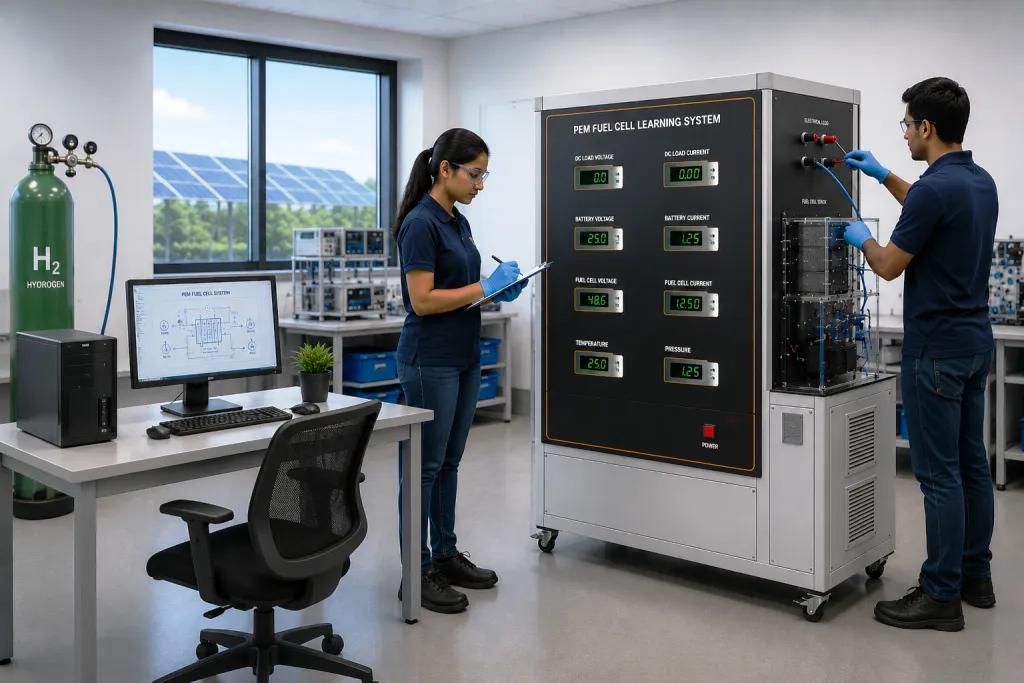
The PEM Fuel Cell Learning System takes dry hydrogen in and delivers AC and DC electrical power out — with every parameter between fully instrumented and measurable. The 1000W PEM fuel cell stack receives dry hydrogen at 0.45–0.55 bar from a 47-litre high-pressure cylinder filled to 150 bar. The fuel cell generates electricity at 28.8V and 35A at rated output. Because fuel cell voltage drops with increasing load, the output is routed through a 1kW PWM charge controller that charges a 24V battery bank and maintains stable output voltage. The battery feeds a 1650 VA home inverter for AC loads and directly supplies DC loads through the measurement panel. Students can connect a 300W AC lamp load or a variable rheostat DC load and observe real-time voltage, current and power at the fuel cell terminals, battery and load — using three DC voltmeters, three DC ammeters, an AC voltmeter, AC ammeter, rotameter and dual-stage pressure meter. Additional fuel cell stacks can be added in parallel to increase output power, and the system can be developed as a grid-connected or hybrid platform. Power electronics researchers can replace the charge controller and inverter with custom converter topologies to test MPPT algorithms and control strategies.
What's included
Experiments this system enables
Technical features
1000W self-humidified PEM stack
No external humidification system required — the stack manages water balance internally, simplifying operation for student use
Stable output via DC-DC Converter
PWM charge controller decouples the fuel cell from the load, maintaining stable battery voltage regardless of load fluctuation — students observe real-world power conditioning
Complete measurement panel
Three DC voltmeters, three DC ammeters, AC voltmeter, AC ammeter, rotameter and dual-stage pressure meter — full system visibility without external instruments
Scalable
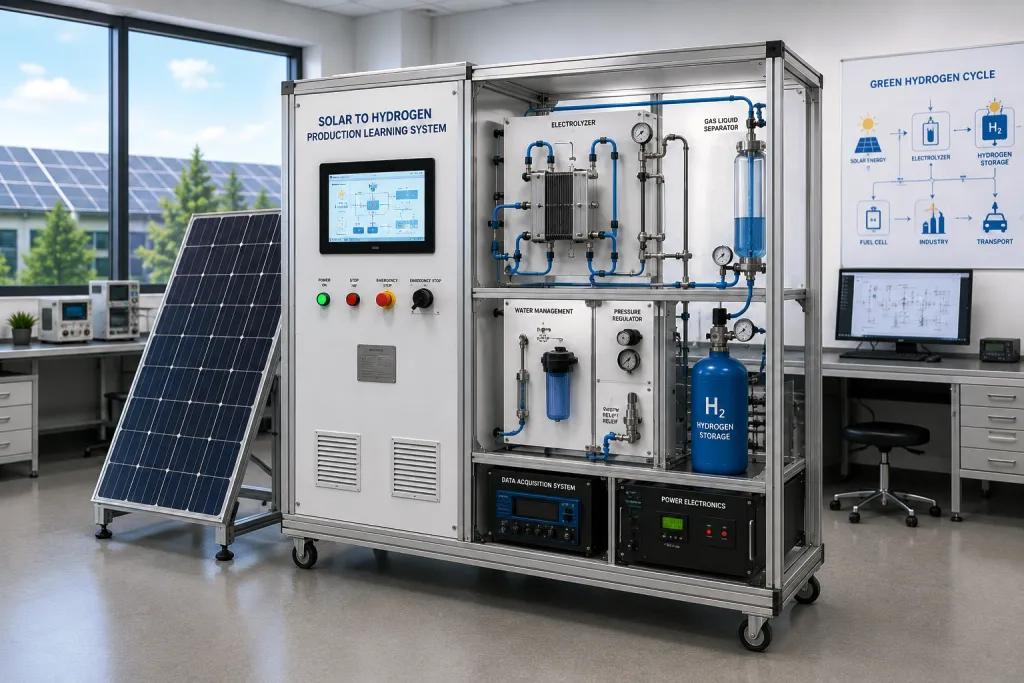
System can be used together with Solar to Hydrogen Production System to showcase complete green hydrogen cycle