What this system does
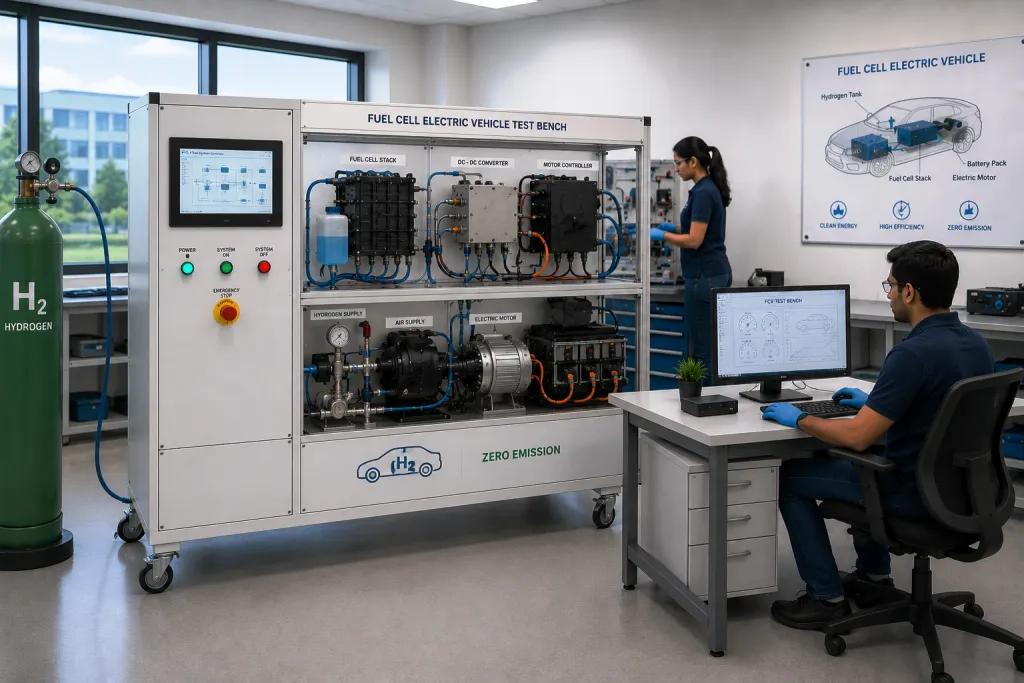
The Fuel Cell Electric Vehicle Learning System brings the architecture of a real fuel cell hybrid vehicle onto a compact, safe, lab-scale test bench. The 2500W closed-cathode PEM fuel cell stack supplies hydrogen from a high-pressure cylinder at 0.55–0.75 bar and generates DC power at 43.2–57.6V. A boost converter raises and regulates this output to a stable 48V DC link. The battery bank and ultracapacitor connect to the DC link through independent bidirectional IGBT converters, replicating the energy management architecture of a production fuel cell vehicle — fuel cell for steady-state power, battery for transient demand, ultracapacitor for peak power and regenerative braking capture. The DC link feeds a three-phase PMSM motor controller driving a 2.5kW PMSM traction motor. The traction motor is mechanically coupled to a PMSM loading motor acting as a generator, whose AC output is rectified and dissipated through a 2.5kW resistive load bank — simulating road load.
What's included
Experiments this system enables
Technical features
Complete hybrid drivetrain architecture
Fuel cell, battery and ultracapacitor connected through independent power converters to a common DC link — identical to the architecture of production fuel cell vehicles
Vehicle dynamics simulation
Full vehicle model — mass, aerodynamic drag coefficient, rolling resistance, gear ratio, road gradient, wheel torque and tank-to-wheel efficiency — computable from the LabVIEW interface
Individual sensor boards
Dedicated voltage and current sensor boards for fuel cell, battery, ultracapacitor and three-phase motor — all parameters visible in real time without external instruments
PEM fuel cell
3kW Air cooled open cathode PEM Fuel Cell