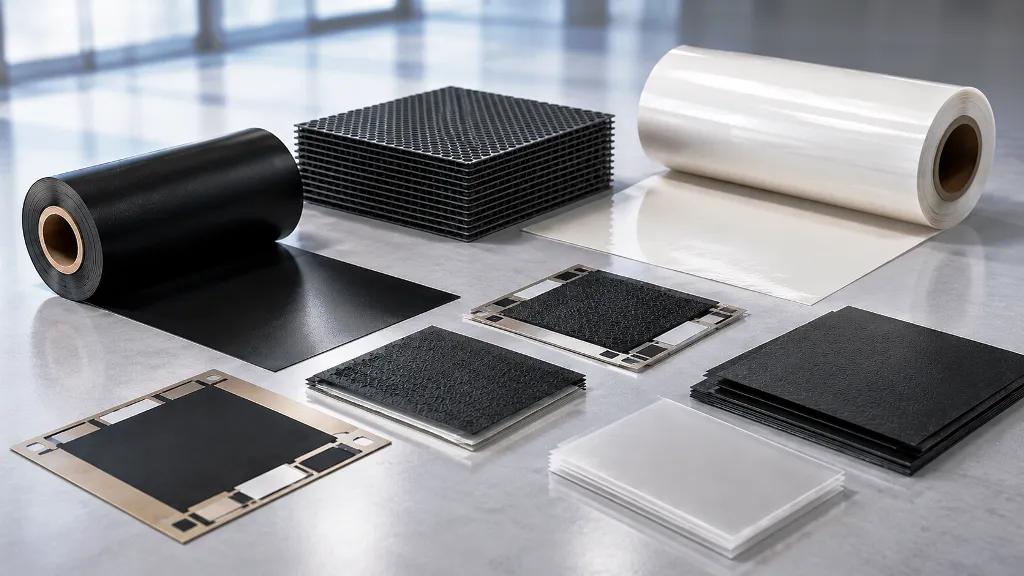
Products being added to this category.
Enquire directly →What is a Bipolar Plate?
A bipolar plate sits between adjacent cells in a fuel cell or electrolyzer stack, performing multiple critical functions: distributing reactant gases across the active area through engineered flow field channels, conducting current between cells, providing structural support to the stack, and separating the anode of one cell from the cathode of the next (hence "bipolar"). Plate design and material selection directly affect stack power density, pressure drop, durability and manufacturing cost.
Three material families are available. Graphite plates offer excellent corrosion resistance and electrical conductivity, with a long track record in fuel cell and electrolyzer applications, though they are more brittle and harder to manufacture at thin gauges than metal alternatives. Metallic plates — typically stainless steel — can be stamped to very thin profiles, enabling higher power density stacks, but require corrosion-resistant coatings to survive the acidic, electrochemical environment inside a PEM cell. Titanium plates offer excellent corrosion resistance, particularly suited to electrolyzer anode-side applications with demanding oxidative conditions.
Bipolar plates in this range use a patented treatment process to ensure long-term sealing tightness and low electrical resistance — both critical to stack efficiency and reliability over the operational lifetime. Custom flow field designs and plate geometries are available for fuel cell, electrolyzer and flow battery stack applications.